
Tale
What is Tale?
Tale is an open-source project workspace for teams that coordinate AI agents, files, and approvals in one place. It combines Shared tasks, Agent delegation, Parallel sandbox work, Approvals & audit, and Knowledge retrieval so people and project agents can draft, review, and finalize work with citations. It connects OpenAI, Anthropic, Gemini, GitHub, Slack, and Gmail. Community is free to self-host; Enterprise is CHF 12 (EUR 14) per user/month, with two months free on yearly billing.
Last verifiedHow we evaluate
At a glance
- Tale is best for teams that want to coordinate AI agents, files, and approvals in one shared workspace.
- Community Free; Enterprise CHF 12/user/mo
- Yes — Tale supports API-backed models and lets you connect local model servers through a supported API.
What it actually is
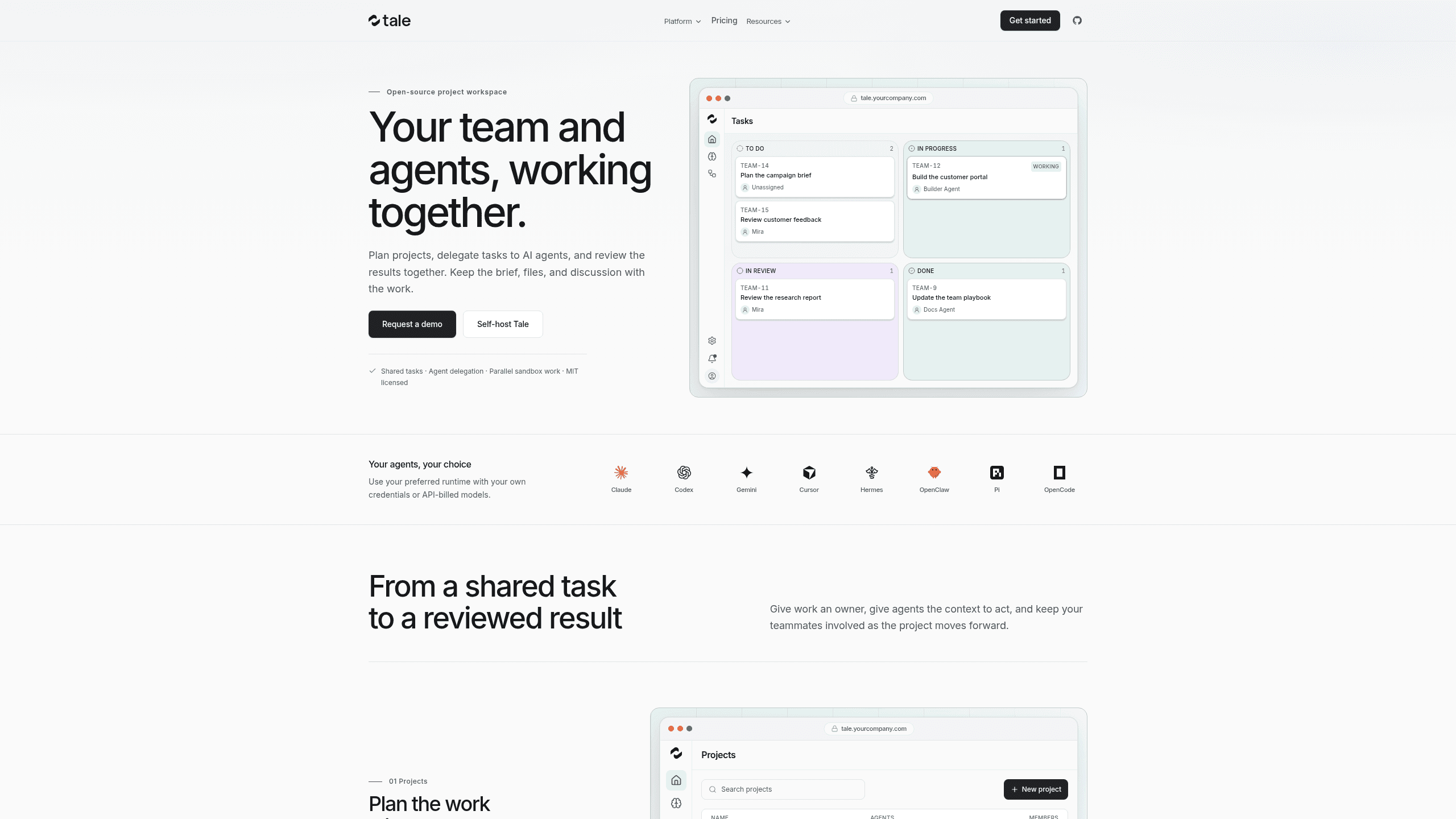
Tale is a project-management workspace — projects, tasks, a kanban-style board — where tasks can be assigned to a teammate or to an AI agent instead of a person. An agent runs in a persistent sandbox using a runtime you bring (Claude Code, Codex, Gemini, Cursor, Hermes, OpenClaw, Pi or OpenCode are listed on the homepage), picks up tasks, and its output — files, chat, a result — comes back to the same task for a human to review before it moves forward. It is not a low-code flow builder like n8n or Make, and not a bare agent framework like CrewAI or LangGraph: the product is the collaboration layer (task ownership, shared context, review) around whichever agent runtime you plug in. Tale's own comparison pages make this framing explicit for ~40 adjacent tools (https://tale.dev/compare).
Governance and audit — unusual for a tool this young
Tale ships an approvals layer: a configured policy can require a human sign-off before an agent's connector action (e.g. sending an email, writing to an external system) executes, and every approval decision and agent action is written to an audit log with actor and timestamp. There are also per-workspace concurrency caps on agent runs (new work queues rather than fails once a limit is hit, as of the v0.5.77 release notes) and budget tracking for metered model usage. Reads and internal writes aren't gated by default — only external connector writes are, per the governance docs (https://docs.tale.dev/platform/admin/governance/audit-logs, https://docs.tale.dev/platform/approvals/concepts). This kind of control surface usually shows up only once a product has enterprise customers pushing for it; seeing it in a project that's under a year old is a genuine point in its favour, though none of it has been tested against production load by a third party we could find.
Pricing
Community edition: every feature, MIT-licensed, free to self-host; support is whatever you get on GitHub. Enterprise: CHF 12 (EUR 14) per user/month (the pricing page's example is 25 users), with two months free on annual billing, covering professional operation (self-hosted or cloud), a DPA, email/phone/remote support and influence on the roadmap. Storage beyond 1TB is +CHF 10/TB/month. Standard installation is a flat CHF 1,990; maintenance, custom development and consulting are each billed at CHF 180/hour. Underlying model usage (OpenAI, Anthropic, Gemini, etc.) is billed separately at the provider's own rates with no markup, per the vendor (https://tale.dev/pricing). All of this is published with real numbers, not "contact sales" placeholders — one of the more transparent pricing pages we've checked.
How young and how small this is
The GitHub repository (tale-project/tale) was created 2025-11-30 and is not archived; it ships near-daily releases (v0.5.77 on 2026-10-07, the day before this check) and has 276 open issues against 32 stars and 5 forks — consistent with active internal development rather than a stalled project (https://api.github.com/repos/tale-project/tale). Of the commit history, two accounts — yannickmonney (1,499 contributions) and larryro (1,242) — account for nearly all of it; a handful of other contributors have made single-digit commits each (https://api.github.com/repos/tale-project/tale/contributors). Yannick Monney is also named as Ruler GmbH's founder on the vendor's own about page. A buyer should read this as: a fast-moving, founder-led project with a tiny bus factor, not yet a broad open-source community — true of almost every MIT-licensed tool at this stage, but it matters for anyone weighing self-hosting against relying on the vendor's roadmap.
Company behind it
Tale is built by Ruler GmbH, a company registered in Spiez, Canton of Bern, Switzerland — confirmed active in the Swiss commercial register under that name and address (https://www.moneyhouse.ch/en/company/ruler-gmbh-15413202401). The vendor's about page states Ruler was founded in 2020 and describes itself as Swiss-based and vendor-neutral, with no ties to a cloud or model provider (https://tale.dev/about). Ruler also claims an ISO 27001 certification covering "Tale Enterprise and professional services" and invites prospects to request the certificate's scope and evidence — we could not independently verify the certificate itself (no certificate number or registrar link is published), so treat the ISO claim as vendor-stated until you've asked for that evidence.
Deployment reality
Self-hosting runs through a published CLI (tale init, tale dev) over Docker Compose, not a from-source build — the documented quickstart explicitly says you don't need to clone the repo or install Bun (https://docs.tale.dev/self-hosted/install/quickstart). It needs Docker with Linux containers, and on ARM64 Linux hosts (not Apple Silicon under Docker Desktop) you must configure amd64 emulation yourself for the bundled object store. A production deployment is a separate, documented step (tale deploy) from the local dev stack, with its own TLS, backup and hardening guides linked from the quickstart.
How much does Tale cost?
| Plan | Price | What's included |
|---|---|---|
| Community | Free |
|
| Enterprise | CHF 12/user/month |
|
Frequently asked questions
What is Tale?
Tale is an open-source project workspace for teams that coordinate AI agents, files, and approvals in one place. It combines Shared tasks, Agent delegation, Parallel sandbox work, Approvals & audit, and Knowledge retrieval so people and project agents can draft, review, and finalize work with citations. It connects OpenAI, Anthropic, Gemini, GitHub, Slack, and Gmail. Community is free to self-host; Enterprise is CHF 12 (EUR 14) per user/month, with two months free on yearly billing.
How much does Tale cost? Is it free?
Community is free to self-host under the MIT licence and has every product feature. Enterprise is CHF 12 (EUR 14) per user/month, with two months free on yearly billing, and adds professional operation, a DPA and support.
What is Tale used for? Who is it for?
Tale is used for Shared tasks, Agent delegation, and Parallel sandbox work. It's built for Product teams, Operations teams, and Engineering teams.
Does Tale have an API and what does it integrate with?
Tale supports API-backed models and lets you connect local model servers through a supported API.
Is Tale open source or self-hostable?
Yes, Tale is open source and can be self-hosted on your own infrastructure.
Our take
Every product feature, including approvals for connector writes, is in the free Community edition. Enterprise adds professional operation, a DPA, support and managed hosting, at CHF 12 per user/month.

Explore other Workflow Automation


