
Duaer
What is Duaer?
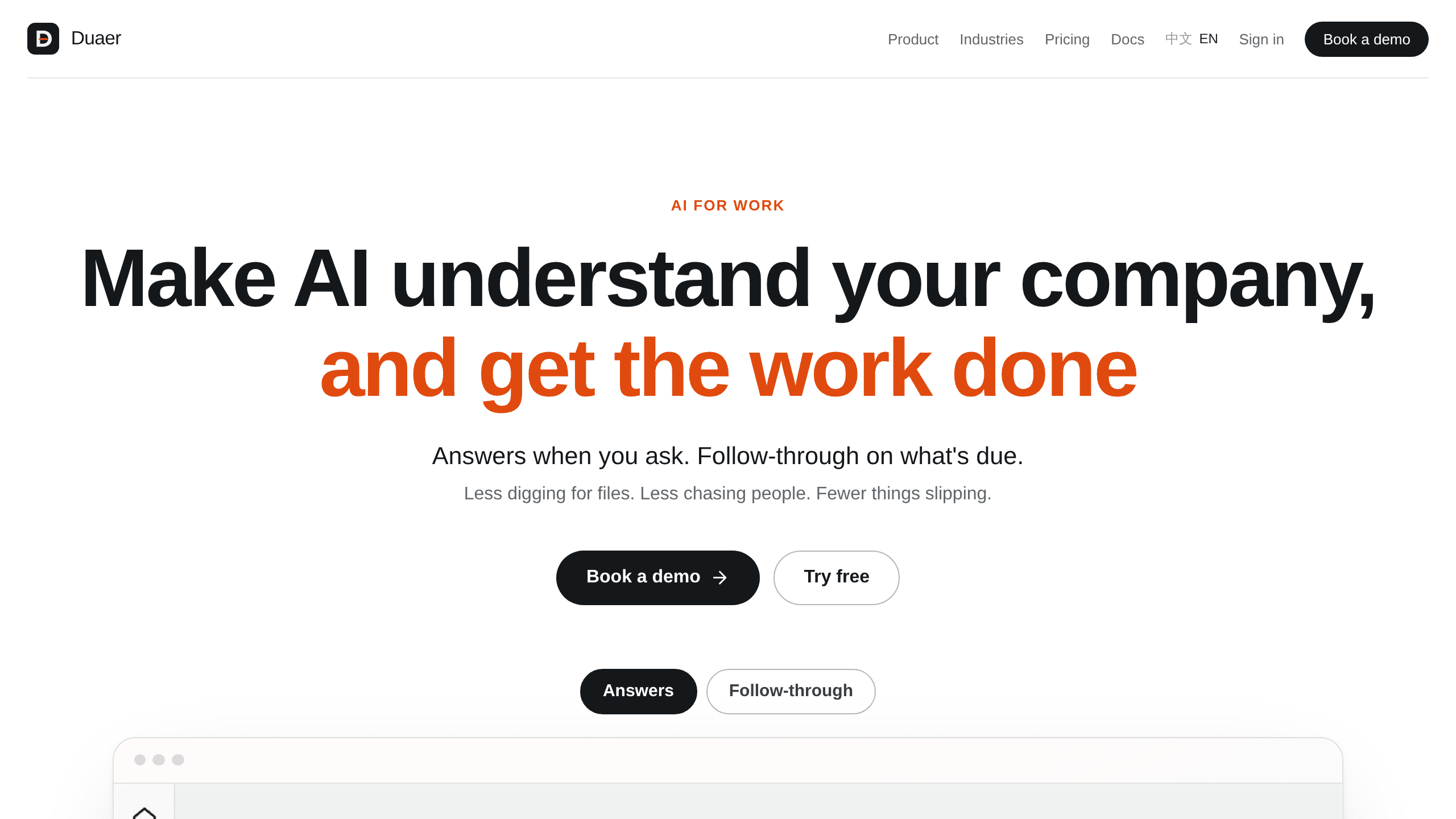
Duaer is an operations knowledge and follow-through tool for teams that turns company documents, chats, spreadsheets, and business systems into answers and routed work inside the apps they already use. It connects Google Drive, Microsoft 365, Slack, and Microsoft Teams, with features like Answers, Follow-through, and permission-aware search. Plans run Hobby free, Starter $24/mo, Pro $60/mo, and Business $800/mo.
Last verifiedHow we evaluate
At a glance
- Duaer is best for operations teams who need company knowledge and overdue work to surface in one place.
- Hobby Free; Starter $24/mo; Pro $60/mo; Business $800/mo
What it does
Duaer connects to the places a company already keeps documents and conversations — Google Drive, Microsoft 365, SharePoint, Slack, Feishu, WeCom, Teams — and lets people ask questions in plain language. According to Duaer's own documentation, answers are restricted to what the asking person is permitted to open in the source system, and each answer cites the file it came from (https://doc.duaer.com/guides/permission-aware-ai-search/, https://doc.duaer.com/guides/ai-answers-with-citations/). On top of that sits a reminder system ('card rules'): time-bound work such as contract renewals, equipment calibration, or SOP steps get an owner and a due date, and a card appears for that owner every day until they mark it handled (https://doc.duaer.com/guides/expiry-date-reminders/, https://doc.duaer.com/guides/follow-up-overdue-work/). The whole thing is built on a drag-and-drop workflow canvas with triggers, nodes and executions — not a chat box with a knowledge base bolted on.
The engine underneath is n8n, and the site does not say so
Duaer's web app is n8n's own editor. The HTML served by duaer.com carries n8n's standard embedded config tags — <meta name="n8n:config:rest-endpoint"> and <meta name="n8n:config:sentry"> with the error-tracking release tag set to '[email protected]' — which is how n8n's self-hosted editor identifies itself in its own built index.html (view-source of https://www.duaer.com/, https://www.duaer.com/pricing). n8n publishes a 2.43.x release line itself (https://github.com/n8n-io/n8n/releases), so the version numbering lines up. Duaer's own changelog confirms it directly: a 0.02 entry documents a 'Microsoft Foundry Chat Model' node and links to n8n's actual upstream package path, n8n-nodes-langchain.lmchatazureopenai, unrenamed (https://doc.duaer.com/changelog/release-notes.md). Its self-hosting documentation reproduces n8n's own environment-variable and edition structure almost verbatim — DUAER_ENCRYPTION_KEY in place of N8N_ENCRYPTION_KEY, and the exact same four edition names n8n uses: Community, Registered Community, Business, Enterprise (https://doc.duaer.com/hosting/community-edition-features.md). Individual doc pages are close paraphrases of n8n's official documentation, in places identical sentence-for-sentence ('A node is an entry point for retrieving data, a function to process data, or an exit for sending data' appears word-for-word in both doc.duaer.com/Duaer-Organizations/components/nodes.md and n8n's own docs at docs.n8n.io). Nowhere on duaer.com, in its Terms of Service, or in its Privacy Policy is n8n mentioned (checked via https://www.duaer.com/terms and https://www.duaer.com/privacy). This matters beyond trivia: n8n's core is distributed under the Sustainable Use License, which permits internal and non-commercial use and modification but says use 'only for your own internal business purposes or for non-commercial or personal use,' and that distributing or providing the software to others is allowed 'only if you do so free of charge for non-commercial purposes' (https://raw.githubusercontent.com/n8n-io/n8n/master/LICENSE.md). Duaer is a paid hosted service charging $24–$800/month for access to that engine. Whether Duaer holds a separate commercial agreement with n8n GmbH for this is not stated anywhere public; it is simply absent from the record.
Pricing
Billing is per workflow execution, with unlimited users and workflows on every tier (verified on https://www.duaer.com/pricing, 2026-10-12): Hobby is free — 1,000 executions/month, 800 AI credits, 1 shared project, 1 GB storage, no card required. Starter is $24/month — 2,500 executions, 2,300 AI credits, 5 concurrent executions, 20 GB storage, 1 custom domain. Pro is $60/month — 10,000 executions, 13,700 AI credits, 3 shared projects, 20 concurrent executions, 100 GB storage, 3 custom domains. Business is $800/month — 40,000 executions, SSO/SAML/LDAP, Git and environments, priority support, 1 TB storage, unlimited custom domains. Annual billing is advertised as roughly 17% cheaper across tiers. AI model usage draws down a separate 'AI credits' allowance on top of the execution count, so a workflow that is light on triggers but heavy on model calls can exhaust credits well before it exhausts executions.
The free public-data layer
Beyond the business-document connectors, Duaer ships hundreds of ready-made 'Duaer Data' skills wrapping free public APIs — life-science databases (UniProt, ChEMBL, ClinVar, PDBe, GEO, Ensembl, PubMed), regulatory and financial sources (SEC EDGAR full-text search, FDA openFDA endpoints, World Bank and IMF indicators, GLEIF legal-entity lookups), and general reference data (USGS earthquakes, Open-Meteo weather, Wikipedia, arXiv) — each costing one credit per successful call (catalogued at https://doc.duaer.com/llms-full.txt, sampled 2026-10-12). This is a genuinely unusual breadth for a workflow tool in this price range and reads as a deliberate bet on research- and compliance-adjacent use cases rather than generic business automation.
Maturity and company transparency
Duaer's own changelog states plainly: 'The Duaer public version is 0.02. 0.01 was the first.' (https://doc.duaer.com/changelog/release-notes.md). Its Terms of Service state 'Duaer is in early release and may change, add, or remove features' (https://www.duaer.com/terms). Its GitHub organization was created 2026-09-20 — three weeks before this listing — and holds no public repository for the product itself, only a spec-driven-development methodology repo and a skills-catalog repo (https://api.github.com/orgs/Duaer, https://github.com/Duaer). One changelog entry documents a feature — an 'Employee market' for hiring other users' digital employees — that was 'Retired on 2026-10-08,' three days before this listing, which is a normal thing for an early product to do but is worth knowing if that feature is why you looked. No legal entity name, company address, founders, or funding is disclosed on duaer.com, its Terms, or its Privacy Policy; the Privacy Policy states only that data is stored on servers in Singapore (https://www.duaer.com/privacy) and support runs through a single [email protected] address.
How much does Duaer cost?
| Plan | Price | What's included |
|---|---|---|
| Hobby | Free |
|
| Starter | $24/mo |
|
| Pro | $60/mo |
|
| Business | $800/mo |
|
Frequently asked questions
What is Duaer?
Duaer is an operations knowledge and follow-through tool for teams that turns company documents, chats, spreadsheets, and business systems into answers and routed work inside the apps they already use. It connects Google Drive, Microsoft 365, Slack, and Microsoft Teams, with features like Answers, Follow-through, and permission-aware search. Plans run Hobby free, Starter $24/mo, Pro $60/mo, and Business $800/mo.
How much does Duaer cost? Is it free?
Duaer has a free plan, with paid tiers including Starter at $24/mo, Pro at $60/mo, Business at $800/mo.
What is Duaer used for? Who is it for?
Duaer is used for Answers, Follow-through, and Find anything in one question. It's built for Operations managers, Knowledge workers, and New hires.
Does Duaer have an API and what does it integrate with?
It integrates with Feishu, WeCom, Google Drive, Microsoft 365, Slack, and 1 more.
Our take
Check whether the 1,000 workflow executions/month Hobby cap is enough for your pilot, since Starter raises it to 2,500 and Pro to 10,000. If your follow-through volume is already close to those limits, the jump to Business may be the practical ceiling.

Explore other Workflow Automation


