
GrantCue
What is GrantCue?
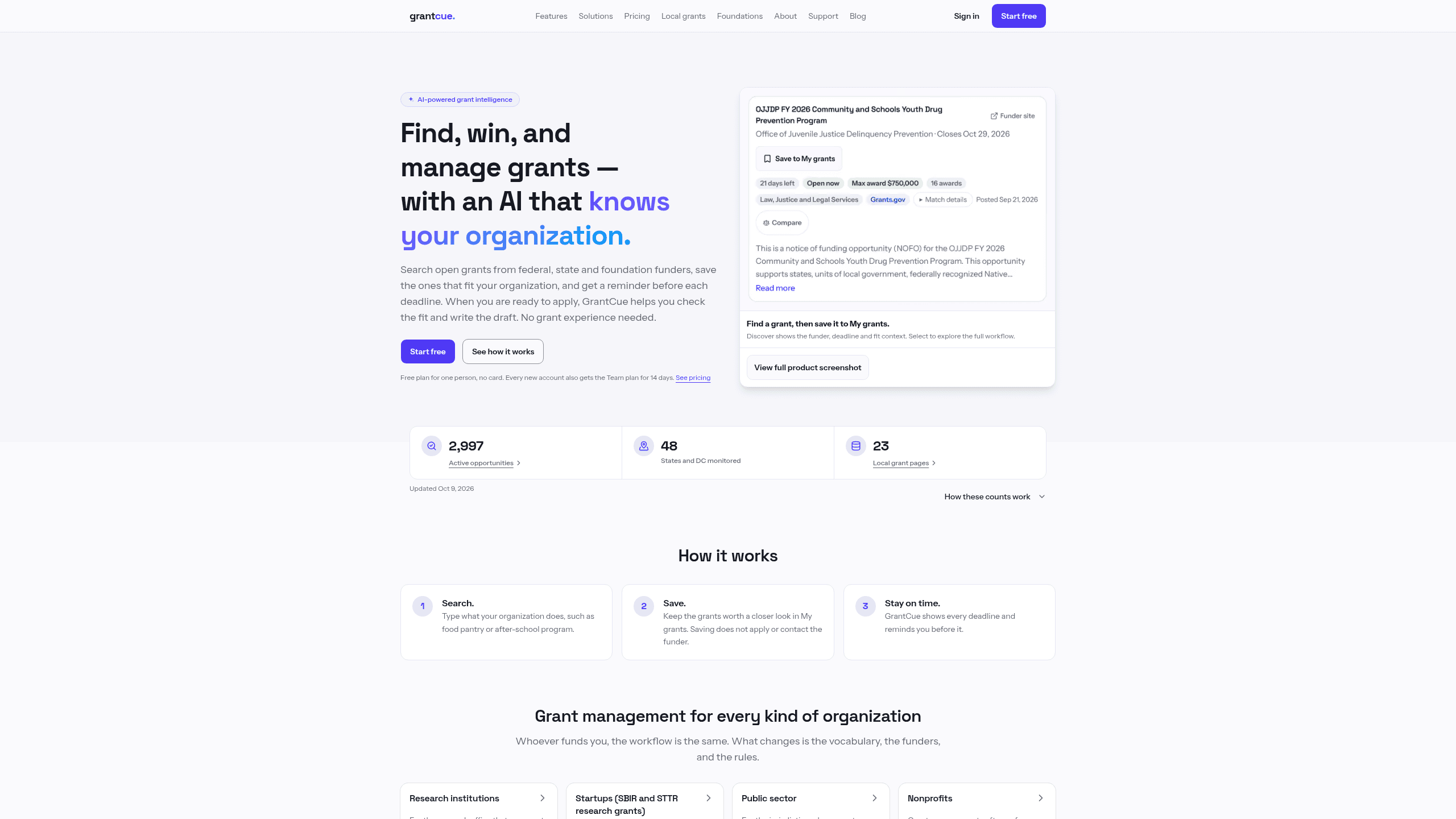
GrantCue is a grant management platform for grant-seeking teams that handles discovery, tracking, and proposal prep in one workflow. It combines AI-powered recommendations, Instant NOFO Summaries, a visual Kanban board, automatic tagging, and a writing workspace for drafting proposal sections. GrantCue also integrates with Slack, Microsoft Teams, and Google Calendar, and plans run Free, Essentials $49/month, Team $109/month, Organization $229/month, and Enterprise custom pricing.
Last verifiedHow we evaluate
At a glance
- GrantCue is best for grant-seeking teams who need discovery, tracking, and drafting in one place.
- Essentials $49/mo; Team $109/mo; Organization $229/mo
- 14 days
- Yes — The site includes an API page under its developer section.
What it actually does
GrantCue has three linked parts: a search/discovery layer over Grants.gov and some state and foundation sources, refreshed nightly (the homepage reports 2,997 active opportunities and 48 states/DC monitored as of October 9, 2026, with 23 local/community pages); a Kanban pipeline for moving saved opportunities through stages like Researching, Drafting, Submitted, Awarded, with tasks, deadlines and an ICS calendar feed; and an AI writing workspace that drafts proposal sections from an organization profile and content library. Post-award tracking (budgets, disbursements, compliance) is on the Team plan and up.
Pricing: real numbers, real free tier
Free: $0, 1 user, 10 grants tracked at once, Grants.gov search, core Kanban, ICS feed, 3 AI NOFO summaries/month, no card required. Essentials: $49/month ($39 billed annually), 3 users, 75 grants, full AI writing tools. Team: $109/month ($89 annually), 8 users, 250 grants, the proposal assistant, Slack/Teams/Google Calendar integrations, webhooks. Organization: $229/month ($189 annually), 20 users ($5/user beyond that), unlimited grants, RBAC, audit trails, SSO on request. Enterprise is custom. A 25% nonprofit discount applies to any paid plan, and every new workspace gets 14 days of the Team plan free before dropping to Free (nothing saved is lost). The jump from Free to the first paid tier is real: Free caps at 10 tracked grants and has no AI writing workspace, so a team that needs the drafting tools is choosing between $0 and $39-49/month, not a smaller intermediate step.
Price against the obvious alternative
GrantCue's own comparison page puts Instrumentl's cheapest plan (Discover) at $299/month billed annually ($3,588/year) for 3 users, against GrantCue Essentials at $39-49/month ($468-588/year) for the same seat count — a roughly $3,000/year gap, verified directly against instrumentl.com/pricing. The page is unusually candid about why: Instrumentl is built for finding new private-foundation funders (450,000+ funder profiles, per Instrumentl's own page), which GrantCue does not do — its free foundation directory lets you look a funder up but does not match or prospect for you. The same page states plainly "most 'honest review' pages for software are written by a competitor or an affiliate, and this one is written by a competitor," and tells readers to check Capterra/G2 themselves rather than trust the comparison.
The AI writing tools are built with hallucination in mind
The documentation and feature pages describe the AI drafting tools (Generate, Refine, Expand, Condense) as working from the organization's own profile and content library, with missing facts rendered as "[placeholders]" rather than invented numbers, and each AI suggestion listing the material it was given so a user can check it before accepting. The vendor also states plainly, in its own glossary, that "a fit or readiness score is not a promise of funding" and that a Kanban card marked Submitted "records a stage only; it does not submit anything" to the funder. This level of hedging against AI overconfidence, documented in the product's own user guide rather than a marketing page, is specific enough to be a genuine design choice rather than a liability disclaimer.
A free foundation directory worth knowing about on its own
Separate from the paid product, GrantCue publishes a free, no-login directory of 11,279 U.S. private foundations built from IRS Form 990-PF e-filings (2021-2025), with grants paid, typical grant size, and top recipient states per foundation, plus a CSV download of the whole dataset. The inclusion rule (at least $1M paid across at least 5 grants) and known limits (filings lag real activity by a year or more, amended returns aren't reconciled) are documented on a methodology page. This is independently checkable — it's built from a named, public IRS data source — and useful to someone who never signs up for the paid product.
Security page is detailed, but the marketing copy oversells two of its own facts
GrantCue's dedicated security page is more specific than most SaaS vendors publish at this size: TLS in transit, Supabase-managed encryption at rest, AES-256-GCM encryption applied specifically to stored secrets (OAuth tokens, webhook signing secrets, 2FA secrets), Postgres row-level security enforced at the database layer (not just app checks), TOTP two-factor sign-in with org-level enforcement, named rate limits, and a daily backup with 7 days' retention and point-in-time recovery explicitly stated as off ("in the worst case up to a day of changes could be lost"). It also lists its AI sub-processors by name: Anthropic (Claude, for drafting/summaries/scoring) and OpenAI (for embeddings used in matching). Against that, the separate /features page markets "Automated Backups — Point-in-time recovery with automated backups" and "All data is encrypted in transit and at rest using industry-standard AES-256 encryption" — both of which the more detailed security page contradicts or narrows (PITR is off; AES-256-GCM is applied to specific secrets, not described that way for all data, with bulk storage encryption instead handled by Supabase's own at-rest encryption). The security page is the one to trust; the features page restates it loosely.
Company size and maturity
GrantCue says on its About page that it is built by a small team headquartered in Clinton County, Pennsylvania (population approximately 37,000), and frames itself as originating from that community's nonprofits and municipalities. The product's launch blog post is dated November 29, 2025, making it under a year old as of this review. No independent reviews were reachable: Capterra, G2 and Product Hunt all returned bot-detection pages rather than content, and general web search was unavailable this session, so reception beyond the vendor's own site could not be verified. Crunchbase and Wellfound profiles are linked from GrantCue's own find-us page but could not be fetched to confirm funding or headcount.
How much does GrantCue cost?
| Plan | Price | What's included |
|---|---|---|
| Free – Personal | $0/month |
|
| Essentials | $49/month |
|
| Team | $109/month |
|
| Organization | $229/month |
|
| Enterprise · Custom pricing | Custom |
|
Frequently asked questions
What is GrantCue?
GrantCue is a grant management platform for grant-seeking teams that handles discovery, tracking, and proposal prep in one workflow. It combines AI-powered recommendations, Instant NOFO Summaries, a visual Kanban board, automatic tagging, and a writing workspace for drafting proposal sections. GrantCue also integrates with Slack, Microsoft Teams, and Google Calendar, and plans run Free, Essentials $49/month, Team $109/month, Organization $229/month, and Enterprise custom pricing.
How much does GrantCue cost? Is it free?
GrantCue has a free plan, with paid tiers including Essentials at $49/month, Team at $109/month, Organization at $229/month.
What is GrantCue used for? Who is it for?
GrantCue is used for AI-powered recommendations, Evidence-backed fit, and Automatic tagging. It's built for Sponsored programs and research administration teams that need a shared grant pipeline, Nonprofit grant writers, and Public-sector managers.
Does GrantCue have an API and what does it integrate with?
The site includes an API page under its developer section. It integrates with Grants.gov, Microsoft Teams, Outlook, Apple, Word, and 6 more.
Our take
Check whether your team will outgrow the free plan's 10-grant cap and 3 AI NOFO summaries per month. If you need Slack or Teams integrations, those start on Team, while custom roles and audit trails require Organization.

Explore other Workflow Automation


