
At a glance
- Tags
- Freemium, Free trial
For developers
- Works with
- Grants.gov, Microsoft Teams, Outlook, Apple, Word, PDF and 5 more
A grant catalog, a tracking board and an AI writer in one app
GrantCue has three parts that share one workspace. Discover is a search layer over Grants.gov, SBIR.gov topics, 748 state and state-agency sources and selected local, foundation and corporate programs. On November 7, 2026 the homepage counted 3,769 active opportunities, 53 states, DC and territories, and 871 local grant pages. My grants is a board where saved grants move through stages with owners, tasks, approvals, automation rules and reminders. The writing workspace drafts proposal sections from the organization's profile and the grant, and post-award tracking covers budgets, payments and compliance.
Beside the paid app sits a free foundation directory built from IRS Form 990-PF filings, readable with no account. The directory page gives 11,361 foundations with a public profile, each showing grants paid, typical grant size and largest awards. The vendor rounds that number differently on other pages: "11,000+" on About and "more than 10,000" on the Instrumentl comparison.
The Free plan keeps the workflow and rations the AI
The pricing page charges one price per organization, with users capped by plan: Free $0 for 1 user and 10 tracked grants, Essentials $49 a month for 3 users and 75 grants, Team $109 for 8 users and 250 grants, Organization $229 for 20 users and unlimited grants. Enterprise is custom and adds SSO/SAML. Billed annually the paid plans come to $39, $89 and $189 a month ($468, $1,068 and $2,268 a year, charged up front).
What Free withholds is mostly AI. Post-award budgets, payment schedules and compliance tracking also sit in the Free column of the plan table. The real gaps come further up: API keys, the proposal assistant, Salesforce and Raiser's Edge NXT import and award agreement reading start on Team, and QuickBooks Online spend import on Organization.
Three discounts sit on top. A founding price of $29 for Essentials or $69 for Team is offered to the first ten paying customers, locked for 12 months and not combinable with the nonprofit code. Invoice and purchase order billing is only available on annual plans; monthly plans are paid by card.
It undercuts Instrumentl on price and concedes prospecting
The vendor's own Instrumentl comparison puts Instrumentl Discover, its cheapest plan, at $299 a month billed annually ($3,588 a year) or $349 monthly for up to 3 users, against $468 a year for GrantCue Essentials, a gap it gives as $3,120. Those Instrumentl figures are the vendor's reading of Instrumentl's page on October 6, 2026, not GrantCue prices.
The page states where it loses: "Instrumentl is the stronger tool for finding new foundation funders." GrantCue's foundation data comes from 990-PF filings for private foundations, plus a smaller checked set of community foundations and public charities. It also calls itself out as a biased source: "this one is written by a competitor", and it tells readers to check the Capterra and G2 ratings themselves.
The AI output is framed as a draft for a person to check
The product pages keep restating limits on what the AI and the board do. The homepage says "Saving does not apply or contact the funder." The features page says "A fit score is not the chance of an award" and that each match shows "The evidence used, and what is not yet known". Award agreement reading on Team turns a PDF into tasks, payment dates and compliance items "for you to review", and works on text PDFs only, per the plan table.
The models belong to other companies. GrantCue makes that choice, not the customer. The same policy keeps Google data out of model training but does not say how workspace text sent to either provider is treated.
A small REST API on Team, and a public MCP server on every plan
Keys get scopes (catalog:read, pipeline:read, pipeline:write), an optional expiry, and are stored only as a SHA-256 hash. Writing is narrow: a key can add a catalog grant to My grants, and "It cannot edit or delete anything." Limits are 120 reads and 30 writes a minute per key, and every key use is logged.
The MCP endpoint is separate and needs no key or account. Its four tools, search_grants, get_grant, search_funders and get_funder, are all read-only and serve only public listings and foundation profiles; "It never reads an account, an organization or My grants."
Security is described in detail, with no audit and no uptime promise
The security page is specific. Postgres row-level security separates organizations at the database, so a request sent straight to the database API meets the same rules. Connected-app tokens, webhook secrets and two-factor secrets get AES-256-GCM encryption on top of Supabase's encryption at rest. Admins can require two-factor sign-in for everyone.
The same page states its limits. "Point-in-time recovery is off, so in the worst case up to a day of changes could be lost", from a daily backup with the last 7 kept. Upload scanning checks a file's fingerprint against VirusTotal's records, and a file VirusTotal has never seen gets no verdict. A stricter Content-Security-Policy runs in report-only mode and "is not yet enforced". Data is held in Supabase's US East (Virginia) region, and "No plan includes a contractual uptime commitment." No SOC 2 or ISO audit is named on the site. The features page now describes backups the same way, as "A daily backup of the database, with the last seven kept".
A small Pennsylvania company with one named builder
The site footer names the operator: "Redbrook Technologies, LLC, the company behind GrantCue", and adds "Built by Thomas Darby." The About page says the product is "built by a small team in rural Pennsylvania", based in Clinton County, which it describes as a community of about 37,000 people. Funding, headcount and outside investors are not stated anywhere on the vendor's pages.
That scale fits the buyers the plan cards name: a single grant writer at a small nonprofit, a town or a school district on Essentials, up to large nonprofits, counties and universities on Organization. A team that has to have SAML sign-in below Enterprise, a contractual SLA, a named security audit or data stored outside the US will not find them on the published plans.
GrantCue price and terms
Terms
- Free plan
- YesYesFree plan: 1 user, 10 tracked grants, 3 AI NOFO summaries a month, 50 MB and 10 documents of storage, no AI drafting
The terms in full
Every new workspace first gets 14 days of Team free with no card.
- Card to start
- YesNot required
- Sign up without sales
- YesYes
What needs a higher plan
- Team
- Public API
- Enterprise
- Single sign-on
For AI agents
- MCP server
- Yes
- API
- PartlyTeam
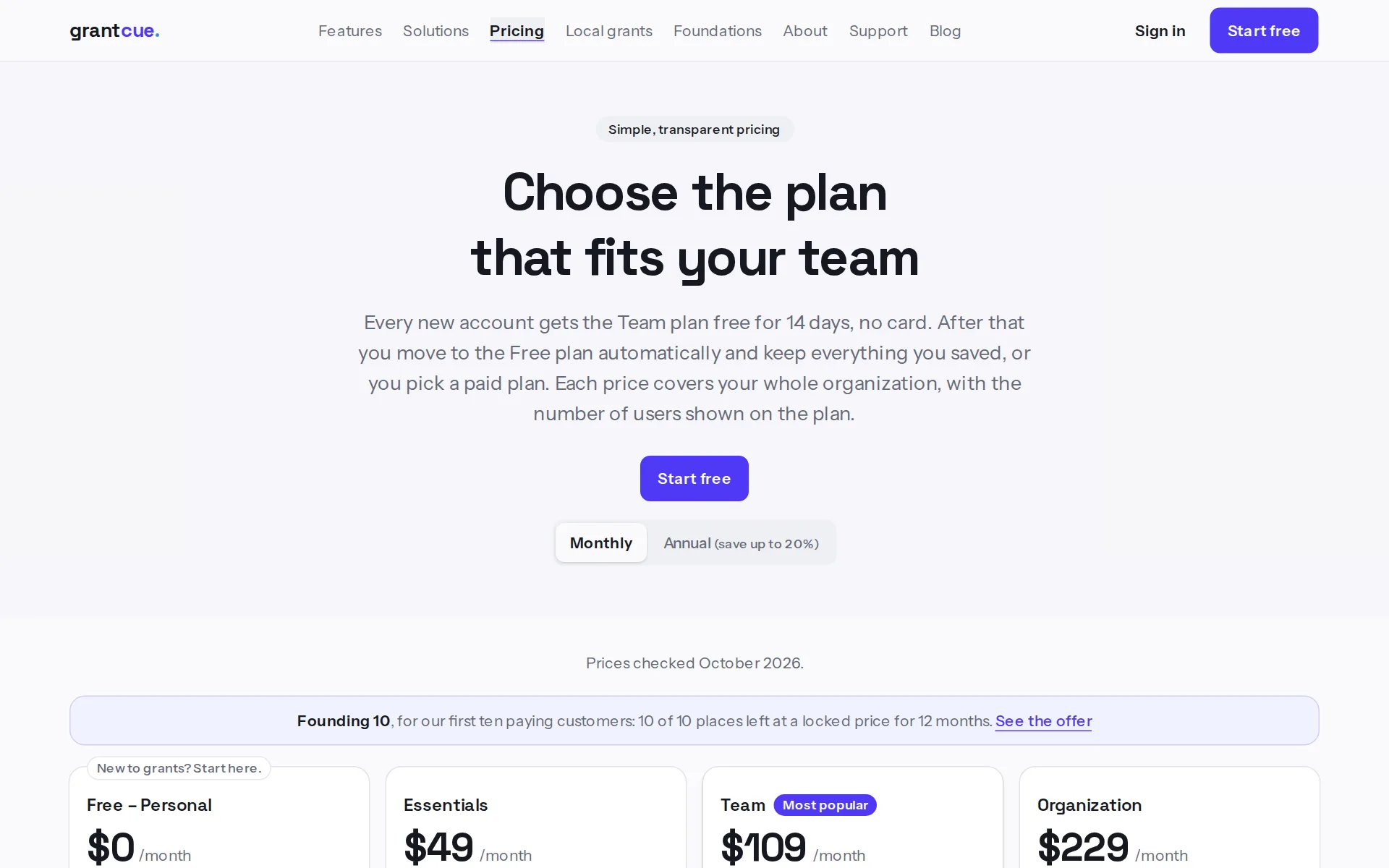
Pricing page, captured
grantcue.com/pricing, checked
What we checked on GrantCue
What the price counts
Public plans charge a flat monthly organization price, while Enterprise uses custom pricing.
Each price covers your whole organization, with the number of users shown on the plan.
grantcue.com/pricingChecked
Free tier
A standing Free plan for one user with 10 tracked grants and 3 AI notice summaries a month, after a 14-day Team trial.
Your workspace moves to the Free plan: 1 seat, 10 tracked grants, 3 AI summaries a month
grantcue.com/pricingChecked
Self-serve signup
Paid plans are bought online by card from the pricing page; only Enterprise and invoice or purchase order billing go through sales.
Yes, on annual Essentials, Team, Organization and Enterprise plans. Monthly plans are paid by card.
grantcue.com/pricingChecked
Card to start
No card is needed for the trial or the Free plan, and nothing is charged until a paid plan is chosen.
No. The trial starts the moment your workspace is created and nothing is charged unless you choose a plan.
grantcue.com/pricingChecked
Contract
Monthly and annual billing are both offered with no seat minimum; annual is charged up front for the year.
Monthly and annual plans can be upgraded, downgraded or cancelled at any time from Settings → Billing.
grantcue.com/pricingChecked
Cancel any time
Cancel any time from billing settings with no fee; the plan runs to the end of the paid period, and the terms say fees are non-refundable.
Cancelling keeps your plan active until the end of the period.
grantcue.com/pricingChecked
Works with
Google Calendar, Slack, Microsoft Teams and webhooks on every plan; Salesforce and Raiser's Edge NXT read-only import from Team; QuickBooks Online spend import on Organization.
Calendar feed, Google Calendar sync, Slack and Microsoft Teams alerts, and webhooks; Search grants and foundation profiles from Claude or ChatGPT
grantcue.com/pricingChecked
Public API
A documented REST API with an OpenAPI 3.1 spec covers catalog search and My grants, but only on Team and higher, and it cannot edit or delete grants.
The API is included with the Team plan and higher.
grantcue.com/developersChecked
MCP server
A public MCP server with four read-only tools searches grant listings and foundation profiles from Claude or ChatGPT; it never reads account data or My grants.
AI assistants can search GrantCue through a public Model Context Protocol endpoint. It needs no key and no sign-in, and it serves only public data
grantcue.com/developersChecked
Acts on its own
Automation rules move grants and send reminders on their own, but AI output such as award agreement extraction is handed to a person to review, and saving never applies to a funder.
AI that reads an award agreement into tasks, payment dates and compliance items for you to review (text PDFs)
grantcue.com/pricingChecked
Limits on what it may do
Admin, contributor and view-only client roles limit what members do, and each API key is given chosen scopes and an optional expiry.
An organization admin creates keys in Settings, Integrations, API keys, picks what each key may do, and optionally sets an expiry.
grantcue.com/developersChecked
No code needed
A hosted web app where search, tracking, automation rules and drafting are set up in the interface; only the optional API needs code.
When you are ready to apply, GrantCue helps you check the fit and write the draft. No grant experience needed.
grantcue.comChecked
Retention you control
Workspace content stays until you delete it and account data is removed 30 to 90 days after closure, but audit and security logs have no fixed deletion schedule.
Workspace content (tasks/files/notes): retained until you or your organization delete it or terminate the workspace.
grantcue.com/privacyChecked
Data stays in your region
Data is stored in one stated region, Supabase in US East (Virginia), with no option offered to pick another location.
The database and file storage run on Supabase in the US East (Virginia) region.
grantcue.com/securityChecked
Take your data out
Grants, tasks and comments export as CSV or Excel on every plan, and the account and its personal data can be deleted.
Export your grants, tasks and comments, or delete your account and its personal data.
grantcue.com/featuresChecked
Security audits
The privacy policy states alignment with GDPR, UK GDPR and California CPRA/CCPA, refers to data processing terms and uses Standard Contractual Clauses; no audit report is published.
This policy is drafted to align with common global standards (GDPR/UK GDPR transparency requirements and U.S. state privacy laws, including…
grantcue.com/privacyChecked
Single sign-on
SAML single sign-on through your identity provider is an Enterprise feature; lower plans offer Google or Microsoft account sign-in only.
Everything in Organization, plus:SSO/SAML single sign-on
grantcue.com/pricingChecked
Audit log
An activity log of who changed what is included on every plan, and every API key use is also logged.
Admin, contributor and view-only client roles (clients don’t use a seat), with an activity log
grantcue.com/pricingChecked
Uptime promise
The security page states outright that no plan carries a contractual uptime commitment, and daily backups mean up to a day of changes could be lost.
No plan includes a contractual uptime commitment.
grantcue.com/securityChecked
Its own model
The AI features run on Anthropic's Claude models, with OpenAI used for embeddings and for some features; the vendor trains no model of its own.
AI Processing: Anthropic (Claude models for proposal drafting and editing, summaries, scoring and recommendations, and extracting details from…
grantcue.com/privacyChecked
You pick the model
The vendor sets which model each AI feature uses, Claude or an OpenAI model; the pages offer the customer no model picker.
an AI feature that GrantCue sets to an OpenAI model instead of a Claude model sends OpenAI the text it would otherwise send to Anthropic
grantcue.com/privacyChecked
GrantCue alternatives


Questions about GrantCue
- How much does GrantCue cost?
- GrantCue has a free plan. From grantcue.com/pricing, checked 7 November 2026.
- Does GrantCue have an API or an MCP server?
- It has an API on Team. It has an MCP server.
- What have we checked on GrantCue?
- 21 facts, under these headings: What it costs to start, what it works with, what it does on its own, what happens to your data, whether a company can buy it, which models it runs on.
- How do we check GrantCue?
- We hold 21 facts on GrantCue, quoted from 6 pages. Facts and price last checked 7 November 2026. Last change found 23 October 2026.
Similar in AI assistants for work
- OrkasOpen-source, local-first desktop app where a Commander agent coordinates a team of specialist AI agents.
- ReclaimAI calendar agents that auto-schedule focus time, habits, tasks and meetings on Google or Outlook calendars.
- EmberAI workspace for founders that turns one project context into business plans, pitch decks and B2B prospect lists.


From our research
The GrantCue team has claimed this listing
We check its facts against the GrantCue site.
- Facts checked
- 7 November 2026
Report an error if a fact is wrong.