15 AI Agent Use Cases: Real Tools and Measurable Outcomes by Industry
78% of orgs already use AI agents. Here are 15 real-world use cases with specific tools and ROI data, from customer support to legal document review.

Written by AgentsIndex
Every week, the AI agents space adds new tools, new frameworks, and new claims. Most guides about AI agent use cases respond with a 10-item list of abstract categories, "customer service," "supply chain," "healthcare", with no tools named and no numbers attached. That's not useful if you're trying to build a business case or figure out where to actually start.
The structure used in this guide, one named tool plus one specific metric per use case, appears in zero of the top-10 competitors currently ranking for this topic. IBM, Oracle, and Workday describe use cases conceptually with no tools named and no numbers attached. Every section below follows the same formula: tool, stat, named source, and enough context to act on it. That format is also what AI citation systems extract most reliably, making each section a self-contained, citable passage.
This guide works differently. According to McKinsey's State of AI survey, 88% of organizations reported regularly using AI in at least one business function, up from 78% a year earlier. Gartner predicted that 40% of enterprise applications would feature task-specific AI agents by the end of 2026, up from less than 5% in 2025.
Both figures carry named sources: the 88% adoption figure comes from McKinsey's State of AI report, published in November 2025, and the enterprise-application projection comes from a Gartner press release dated 26 August 2025. That prediction's own horizon runs through the end of 2026, so it hasn't resolved yet, it's still the forward-looking figure Gartner is citing.
The adoption window isn't opening; it's already open. What's still missing from most content on this topic is specificity: which tools, which workflows, and what measurable outcomes should you actually expect?
For each of the 15 use cases below, you'll find a named tool, a specific outcome from real deployment data, and enough context to know whether it applies to your situation. If you want to understand what types of agents exist before diving in, the guide on types of AI agents covers the full taxonomy, reactive agents, goal-based agents, multi-agent systems, and more. This article answers the practical question: what are organizations actually using them for, and does it work?
TL;DR: The 15 highest-impact AI agent use cases span software development, customer support, sales, finance, legal, HR, research, marketing, and workflow automation. Fin reports its customer support agent averages a 76% resolution rate across its customer base. GitHub Copilot users complete coding tasks 55% faster, per GitHub and Microsoft research. Thomson Reuters CoCounsel saves lawyers up to 240 hours per year.
What is an AI agent use case?
An AI agent use case is a specific workflow where an autonomous AI system, one that can plan, take actions, and use tools, replaces or assists a defined business process. Unlike general AI tools that respond to prompts, AI agents execute multi-step tasks end-to-end without constant human input. The difference matters: a chatbot answers "where is my order?" An AI agent finds the order, contacts the supplier, updates the CRM, and emails the customer, without a human directing each step.
That distinction, between responding and acting, is what makes use cases meaningful. The most common confusion is treating any AI feature as an "AI agent." A grammar checker isn't an agent. A tool that autonomously browses the web, calls an API, writes and runs code, then sends a follow-up email based on the results, that's an agent. The capacity to take action, not just generate text, is what defines the category.
The table below maps all 15 use cases to their industry, what the agent does, a representative tool from the AgentsIndex directory, and a measurable outcome from real deployment data. It's the fastest reference for deciding which section to read first.
| Industry | What the agent does | Example tool | Measurable outcome |
|---|---|---|---|
| Software development | Writes code, reviews PRs, runs tests | GitHub Copilot, Cursor | 55% faster task completion |
| Customer support | Resolves tickets 24/7, routes complex cases | Fin (Intercom), Zendesk AI | 76% average resolution rate (Fin's own figure) |
| Sales automation | Qualifies leads, books meetings, updates CRM | Salesforce Agentforce, Clay | Vendors report multiples higher meeting conversion; figures aren't independently benchmarked |
| Finance & accounting | Processes invoices, flags anomalies, audits | Ramp AI, Vic.ai | Up to 20% net AI-driven cost reduction (McKinsey) |
| Legal document review | Reviews contracts, eDiscovery, clause extraction | Harvey AI, CoCounsel | 240 hours saved per lawyer/year |
| HR & recruiting | Screens resumes, schedules interviews, onboards | Eightfold AI, HeyMilo AI | 53% faster onboarding completion |
| Research automation | Gathers sources, synthesizes findings, verifies citations | Elicit, Perplexity | Hours of research compressed to minutes |
| Marketing | Personalizes campaigns, enriches data, scores intent | HubSpot Agent Hub, Clay | Vendors report higher email open/reply rates from behavioral personalization |
| Workflow automation | Connects apps, routes data, handles conditionals | n8n, Make, Zapier Agents | Up to 80% of order decisions automated (Danfoss) |
| IT operations | Monitors alerts, auto-remediates incidents | Datadog Bits AI, PagerDuty | Reduced mean time to resolution |
| Healthcare admin | Clinical documentation, prior auth, scheduling | Microsoft Copilot | Hours of admin time saved per clinician |
| Supply chain | Monitors inventory, predicts disruptions, reorders | Oracle AI agents | Reduced stockouts and lead times |
| Security operations | Threat detection, alert triage, incident response | CrowdStrike Falcon, SentinelOne Purple AI | Faster threat containment |
| Education | Personalized tutoring, adaptive content, feedback | Various | Improved outcomes at scale |
| Personal use | Research, travel planning, coding assistance | Perplexity, Claude, ChatGPT | Hours saved on manual tasks weekly |
How can AI agents improve software development?
GitHub Copilot is an AI coding agent that writes, reviews, and suggests code directly inside your editor. Developers using GitHub Copilot complete coding tasks 55% faster than those without AI assistance, according to a controlled experiment run by GitHub and Microsoft (Kalliamvakou et al., GitHub, September 2022), later corroborated by a peer-reviewed Microsoft Research and GitHub study (Peng et al., 2023). That number comes from controlled experiments, not self-reported surveys, developers given Copilot completed the same tasks in roughly half the time as a control group working without it.
The scope of what AI coding agents can do has expanded well beyond autocomplete. Tools like Cursor, Cline, and Aider operate at the file system level: they read your entire codebase, identify related files, make multi-file edits, run your test suite, and iterate on failures without waiting for instructions at each step. That's a fundamentally different capability from inline suggestions. Devin and OpenHands go further still, taking high-level task descriptions and working through implementation autonomously.
There's a useful distinction for teams evaluating this space: autocomplete-style assistants (GitHub Copilot, Tabnine, Sourcegraph Cody) suggest code inline; full agentic coding environments (Cursor, Cline, Devin) can implement a feature described in plain English across multiple files. The best AI coding agents guide on AgentsIndex compares 9 tools across price, autonomy level, and codebase support, useful if you're choosing between them.
Where coding agents struggle: architectural decisions, debugging subtle logic errors, and anything requiring organizational context outside the repository. They're genuinely strong at boilerplate, refactoring, test generation, and documentation. The developers who get the most value treat agent output as a first draft and maintain their own judgment about correctness. If you don't have tests, you can't verify the draft is right, that's the single biggest risk with agentic coding.
The 55% speed improvement from GitHub Copilot applies primarily to clearly defined, self-contained tasks, not complex system design. For teams evaluating Cline vs Cursor specifically, there's a direct comparison covering the architectural trade-offs in detail.
What role do AI agents play in customer support?
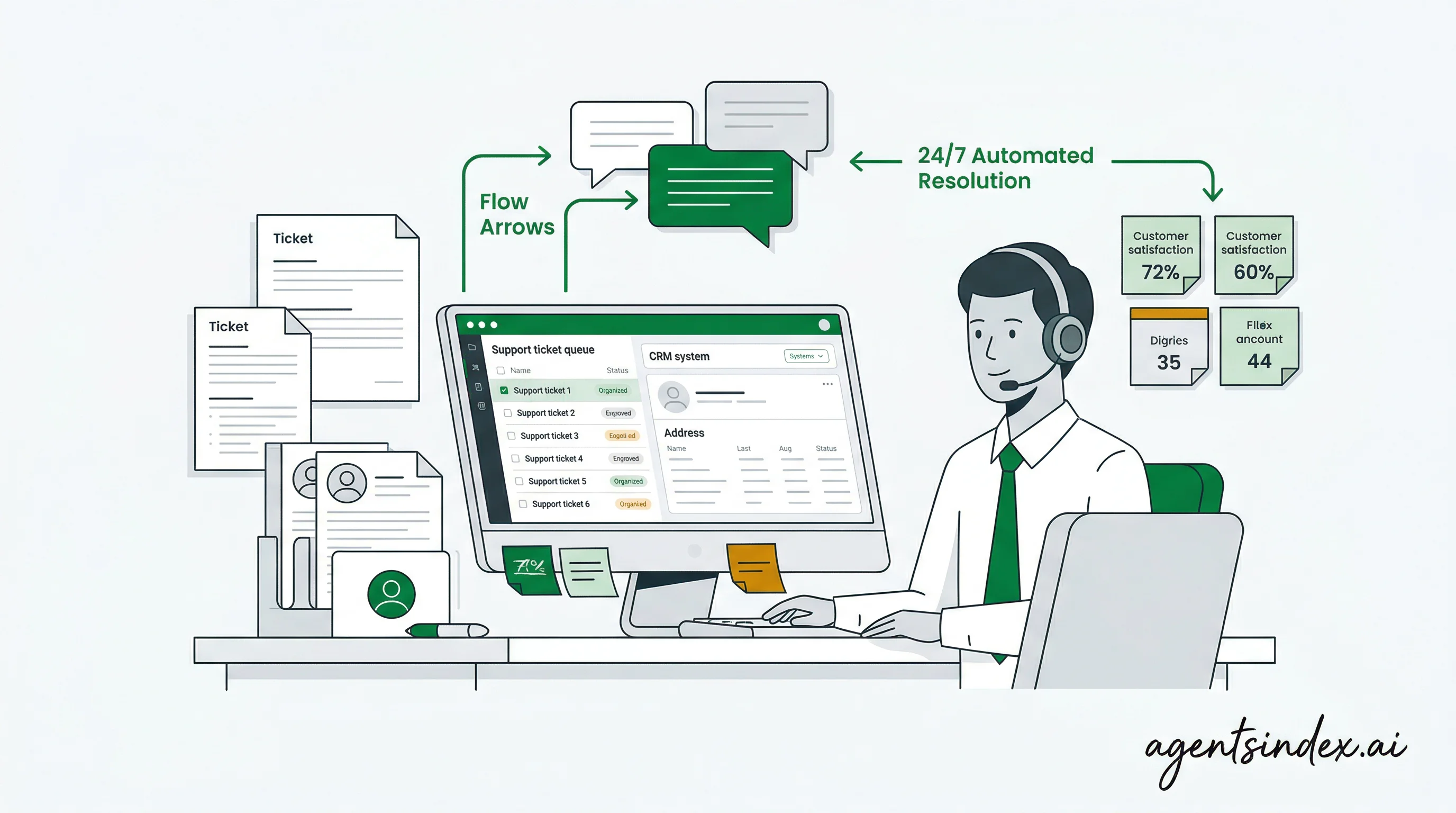
Fin is an AI support agent that resolves customer questions by searching your knowledge base, understanding intent, and responding without human involvement. One naming note: Intercom renamed the company to Fin in May 2026, keeping Intercom as the name of its customer service platform, so you will see this product referred to both ways. Fin reports that its agent averages a 76% resolution rate across 12,000+ customers, with many seeing over 85%. Those are the vendor's own numbers, and as the caveat below explains, they depend heavily on the quality of the knowledge base behind them. Bilt, a fintech handling 60,000 monthly support tickets, routes 70% of them to AI agents through Decagon, saving hundreds of thousands of dollars monthly, according to a Decagon case study that the company no longer publishes on its site.
The business case for customer support agents is more documented than almost any other use case. Freshworks' 2025 Customer Service Benchmark Report found average resolution time dropping from 30 hours to 30 minutes after AI agent implementation, with CSAT scores reaching 94% overall.
That figure comes from Freshworks' 2025 Customer Service Benchmark Report.
Salesforce Agentforce customer Engine reports resolving 50% of inquiries automatically; other customers publish different figures, Falabella automates 60% of interactions autonomously, and Finnair doubled its first-contact resolution rate.
Salesforce publishes these as individual customer outcomes on its Agentforce metrics page, and the results differ substantially from one deployment to the next. "Resolution" is also not defined identically across them, so any single figure is better read as one customer's outcome than as a baseline you should expect.
What actually drives these numbers: support agents work 24/7 with no ramp-up time, no sick days, and no performance variability across shifts. A human agent handling a repetitive billing question at 2am performs differently than one handling it at 10am. An AI agent performs identically at both times. That consistency matters as much as the speed.
The ROI compounds over time. Fin AI's published benchmarks put AI customer service at an average 41% ROI in year one, climbing to 87% in year two and exceeding 124% by year three. That compounding is attributed to the agent improving as your knowledge base expands, routing logic gets tuned, and edge cases get handled. Worth knowing where the number comes from, though: it is a vendor's figure, published without a stated methodology, by a company that sells the product. Treat it as directional rather than as a benchmark. The first deployment is not the best version.
One caveat worth naming: these results assume a well-maintained knowledge base. An AI support agent trained on outdated documentation will give outdated answers confidently. The setup cost is real; the ongoing ROI is also real, but not automatic.
In customer support, AI agents are most commonly used to resolve Tier-1 tickets instantly, billing questions, password resets, order status updates, and route complex cases to human agents with full context already populated, reducing handle time for both the automated resolutions and the human handoffs. Customer service agents and customer support agents are both available to browse in the AgentsIndex directory.
How can sales automation benefit from AI agents?
Clay is a sales intelligence agent that enriches prospect data, scores intent signals, and enables personalized outreach at scale. AI sales vendors commonly advertise meeting-conversion improvements of several multiples over manual SDR outreach, along with lower cost per qualified lead, but these figures come from vendor marketing rather than independently audited benchmarks and vary widely by vendor. Treat any specific multiplier you see quoted as a claim to verify against your own pipeline, not an industry average. Where AI agents do meaningfully lower cost per lead, that matters as much as any conversion lift, pipeline economics change when the same meeting costs less to book.
Tools like Salesforce Agentforce, 11x.ai, and Artisan handle the full top-of-funnel sequence: finding prospects that match your ICP, enriching their contact data, personalizing outreach based on their LinkedIn activity and company news, booking calendar slots, and updating your CRM, without a human touching each step. The SDR's time shifts to the actual conversation once the meeting is booked.
There's a reasonable concern about whether AI-personalized outreach comes across as genuine or just technically personalized. The honest answer: it depends on the quality of the enrichment data and the specificity of the personalization logic. Generic "I noticed you work at [Company]" messages, human or AI, don't convert. Agents that reference a specific funding announcement, a job posting that signals a pain point, or a product launch the prospect was involved in perform significantly better.
AI-personalized email sequences that reference specific, real behavioral data reliably outperform generic campaigns in open and reply rates, though the size of the lift varies too much by vendor and list quality to state as a single multiplier. For sales teams evaluating this category, the sales agents directory on AgentsIndex lists the tools with their data integration capabilities, the most important variable to compare.
How are AI agents transforming finance and accounting?
Ramp AI and Vic.ai are AI finance agents that automate invoice processing, flag anomalous transactions, run compliance checks, and generate financial reports. McKinsey's Global Banking Annual Review 2025 found AI delivering up to 20% net cost reduction for banks, with gross cost reductions as high as 70% in some categories.
That figure comes from the McKinsey Global Banking Annual Review 2025. The same report frames governance and compliance risk, not deployment scale, as the biggest obstacle banks face in capturing that value, and sketches a near-term operating model of one human supervising 20-30 AI agents rather than agents replacing finance staff outright.
Finance isn't experimenting with AI agents anymore, it's deploying them in production workflows.
One large-scale example: JPMorgan's Connect Coach combines 25 specialized AI agents to support prospecting, portfolio analysis, meeting preparation, and call summaries for its wealth-management teams, per a roundup of enterprise agentic AI deployments. That's a substantial commitment in a function where human hours are expensive, though JPMorgan hasn't published efficiency figures for it.
Smaller finance teams benefit differently. Tools like Booke.ai and Datarails handle bookkeeping reconciliation and financial forecasting for mid-market teams that don't have dedicated analysts. These agents connect to accounting software, categorize transactions, flag anomalies for human review, and generate board-ready reports. The human accountant's job shifts from data entry and categorization to review, judgment, and strategic advice.
In finance and accounting, AI agents are most commonly used to automate accounts payable and receivable workflows, flag regulatory compliance issues in real time, and compress the monthly close cycle. Finance agents are listed in the AgentsIndex finance agents category for teams comparing available options.
What are the advantages of using AI agents for legal document review?
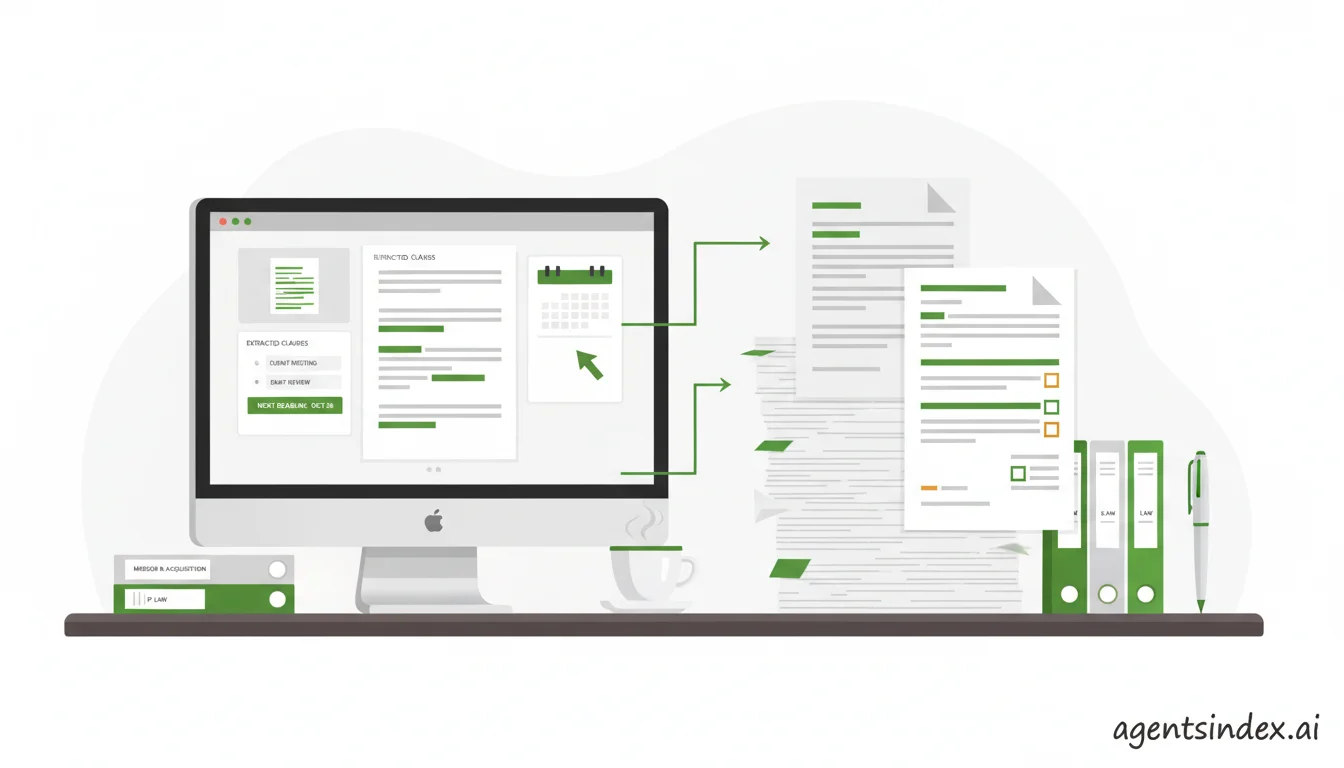
Harvey AI and Thomson Reuters CoCounsel are AI legal agents that review contracts, extract key clauses, flag non-standard language, and perform eDiscovery at scale. Thomson Reuters says CoCounsel Legal reduces time spent on document review tasks by an average of 55%, which it translates to 240 hours saved annually per attorney. That's roughly six full work weeks returned to every lawyer who uses it, time previously spent on mechanical document review rather than legal judgment.
The technical architecture behind enterprise legal AI is worth understanding. Lexis+ with Protege deploys a four-agent orchestration system: an orchestrator agent, a research agent, a web search agent, and a customer document agent. These work in parallel on complex legal workflows, with the orchestrator breaking the task into sub-tasks, routing them to specialist agents, and assembling the results. National Law Review's 2026 AI predictions cited this multi-agent legal architecture as the emerging standard for enterprise legal teams handling high-complexity work.
For heavy document review, the kind that used to mean associates billing hundreds of hours per engagement, Harvey AI and CoCounsel users now bulk-analyze document sets in minutes rather than hours. The implications for law firm economics are significant. As the National Law Review's 2026 analysis puts it: "The transition from AI assistants to AI agents that execute multi-step tasks autonomously represents the year's most significant technical shift."
In legal services, AI agents are most commonly used for contract review (flagging non-standard clauses and missing obligations), eDiscovery (searching and categorizing large document sets), and legal research (synthesizing case law and regulatory guidance across jurisdictions). The legal agents category on AgentsIndex covers the full range of available tools in this space.
How can AI agents enhance HR and recruiting processes?
Eightfold AI is an HR intelligence agent that screens resumes, matches candidates to open roles, and identifies internal mobility opportunities using skills-based matching. AI-powered onboarding cuts completion time by 53%, and gets new hires to full productivity roughly 40% sooner, according to Anglara AI, an AI development consultancy, which in turn credits the figure to a separate 2025 analysis by infeedo.ai. For companies that hire at volume, faster onboarding means faster contribution and less manager time spent on basic orientation tasks.
HeyMilo AI and Paradox Olivia handle the conversational side of recruiting: scheduling interviews, answering candidate questions about benefits and the role, and collecting structured information before the first human conversation. Worth noting: Workday acquired Paradox in October 2025, and Olivia now ships as the Workday Paradox Candidate Experience Agent rather than as an independent product. These agents deflect a meaningful share of Tier-1 HR requests in most deployments, questions like "how do I update my direct deposit?" or "what's the PTO policy for new hires?" that don't require human judgment but do require human time when handled manually.
One honest nuance: AI resume screening can perpetuate hiring bias if the underlying model was trained on historically biased hiring decisions. This is a documented problem in the space. The better platforms, Eightfold, Findem, Manatal, have explicit bias mitigation approaches, but it's worth asking vendors directly how they address it before deploying at scale. Skills-based matching reduces (but doesn't eliminate) this risk by focusing on demonstrated capabilities rather than credential proxies.
In HR and recruiting, AI agents are most commonly used to automate resume screening and initial candidate outreach, answer employee HR questions at scale, and flag attrition risk based on behavioral and engagement signals. The HR and recruiting agents category on AgentsIndex lists the available tools by capability.
How do AI agents automate research tasks?
Elicit is an AI research agent that finds relevant academic papers, extracts key findings, synthesizes evidence across sources, and highlights methodological limitations. Research agents like Elicit and Consensus are used heavily in legal, finance, and academic contexts where thorough sourcing matters and manual research takes significant time. The same Thomson Reuters CoCounsel capability that saves lawyers 240 hours per year is, at its core, a research automation system, one that searches case law and regulatory guidance instead of academic databases.
Perplexity works as a real-time research agent for professionals who need current information with citations rather than a static knowledge base. It searches multiple sources, synthesizes findings into a direct answer, and surfaces source links for verification. For tasks that used to take an analyst 2-3 hours, competitive landscape scans, regulatory change summaries, market sizing, Perplexity-style research agents compress the timeline to minutes.
The value isn't just speed. It's coverage. A human researcher starting from scratch might find 8-10 relevant sources in an hour. An AI research agent can surface 40-50, ranked by relevance, in under a minute. The researcher's job shifts from finding sources to evaluating them, from information gathering to information judgment. That's a better use of the cognitive time of someone who actually knows the domain.
In research workflows, AI agents are most commonly used for literature review, competitive intelligence, regulatory monitoring, and synthesizing disparate information into structured briefing documents. Research agents are listed in the AgentsIndex research agents category for teams comparing available options.
What impact do AI agents have on marketing automation?
HubSpot's agent platform, Breeze Agents, folded into a new Agent Hub that entered beta in July 2026, personalizes email campaigns, scores intent signals, enriches prospect data, and optimizes campaign parameters in real time. AI-personalized email sequences that are grounded in real behavioral data tend to outperform generic campaigns in open and reply rates, the difference between campaigns that generate pipeline and campaigns that generate unsubscribes, though the size of that lift is vendor-reported and varies too much to state as a fixed multiplier.
Clay sits at the intersection of sales and marketing data enrichment. It pulls signals from dozens of sources, LinkedIn activity, funding news, job postings, technographic data, and builds contact profiles that marketing agents use to personalize outreach at a level that was previously only possible with significant manual research per account. For account-based marketing programs, this changes what's operationally feasible.
Jasper handles the content side: generating campaign copy, ad variants, and email drafts personalized by segment, industry, or persona. The meaningful value isn't replacing a copywriter for brand-defining creative work; it's eliminating the bottleneck in producing 50 variants of an onboarding email for different customer segments. That's work that was often skipped entirely because it wasn't worth the time, until it became worth almost no time at all.
In marketing, AI agents are most commonly used to personalize email and ad campaigns at scale, automate content production for high-volume channels, and build richer prospect profiles by enriching first-party CRM data with third-party behavioral signals. The marketing agents category on AgentsIndex covers the full range of available tools.
How can AI agents streamline workflow automation?
n8n, Make, and Zapier Agents are AI workflow automation tools that connect applications, monitor triggers, execute conditional logic, and route data across systems. Danfoss, an industrial manufacturer, automated order management with a Google Cloud agent and reports automating up to 80% of transactional decision-making and communication, saving around five minutes per order, according to the Google Cloud case study. That's not a small pilot, it's a production system making the majority of routine order decisions without a human in the loop.
Workflow agents are the connective tissue between every other use case on this list. A customer support ticket resolved by Fin doesn't just close, it can trigger a workflow that updates the CRM, logs the resolution to Salesforce, and queues a follow-up satisfaction survey in HubSpot. A meeting booked by an AI sales agent triggers a sequence that enriches the prospect's profile in Clay and creates a deal record in your CRM. The agents compound each other's value when connected.
For teams building custom multi-agent workflows, frameworks like CrewAI and LangGraph enable more complex orchestration, where multiple specialized agents collaborate on tasks too complex for a single agent. If you're evaluating options for orchestrating agents across your stack, the CrewAI vs LangGraph comparison covers the architectural trade-offs between the two most-used multi-agent frameworks.
In workflow automation, AI agents are most commonly used to replace manually maintained automation sequences with logic that can handle exceptions, make decisions based on content rather than just triggers, and connect more systems than a human-maintained rule-based workflow can manage. The workflow automation category on AgentsIndex lists tools by integration depth and no-code accessibility.
What are some additional real-world applications of AI agents?
What are the most advanced AI agent use cases?
The nine use cases above represent the most commercially mature AI agent deployments. The six below are real and growing, but either earlier in their deployment curves or less standardized in their tool offerings.
10. IT operations and monitoring
Datadog Bits AI and PagerDuty deploy agents that monitor system health, triage alerts, correlate incidents across services, and initiate auto-remediation workflows. The core value is reducing alert fatigue and mean time to resolution (MTTR) by having an agent investigate an alert before a human engineer gets paged. In high-volume production environments running hundreds of microservices, this isn't a marginal improvement, it's the difference between engineering teams that spend time building and engineering teams that spend time firefighting.
11. Healthcare administration
AI agents in healthcare administration handle clinical documentation (converting voice notes to structured records), prior authorization requests, and appointment scheduling. The technology itself is production-ready, Microsoft Copilot and similar tools are already deployed at health systems. Deployment is slower than in other industries due to regulatory complexity: HIPAA compliance, EHR integration requirements, and liability questions all create friction that doesn't exist in less regulated verticals.
12. Supply chain optimization
Supply chain AI agents monitor inventory levels, predict demand fluctuations, identify supplier risk, and initiate reorder workflows before stockouts occur. The Danfoss example cited in the workflow automation section is also a supply chain story: automating the bulk of order decisions means the company's procurement and fulfillment cycle carries far fewer manual handoffs at each stage. Enterprise adoption is well-established; mid-market deployment is accelerating as the tools become more accessible without requiring custom development.
13. Security operations
CrowdStrike Falcon, SentinelOne Purple AI, and Darktrace deploy AI agents that detect threats, correlate signals across endpoints, and initiate containment actions autonomously. Security operations is one area where the speed advantage of AI agents isn't just a productivity benefit, it's a direct risk management requirement. Threats that take hours to detect and contain cause more damage than those contained in minutes. The security agents category on AgentsIndex covers the available tools for teams evaluating this space.
14. Education and personalized tutoring
AI tutoring agents adapt instruction based on student performance, provide immediate feedback on assignments, and identify learning gaps before they compound. The most capable implementations go beyond answering questions to adaptive curriculum design, changing what a student sees next based on exactly where they're struggling right now. Adoption is growing fastest in higher education and corporate training, where the one-to-one tutoring model scales cost-effectively in ways it doesn't in K-12 contexts.
15. Personal use cases
One segment that most enterprise guides omit entirely is personal use. Related search data shows consistent demand for terms like "AI agent use cases for personal use," covering travel planning, personal research, home automation, and coding assistance for hobbyists. None of the top-10 competitors address this segment. Tools like Perplexity, Claude, and ChatGPT handle multi-step personal research tasks that previously required hours of manual searching, and consumer-facing agent platforms are expanding this category rapidly.
AI agents for personal use are underrepresented in most enterprise-focused guides, but they represent consistent real-world demand. Perplexity for deep research, Claude for complex analysis and writing, ChatGPT for coding assistance and planning, these are AI agents that individuals use to compress hours of research and planning into minutes. The personal assistants category on AgentsIndex indexes the tools built specifically for individual productivity rather than enterprise workflows.
Frequently asked questions
What are AI agents used for in real life?
In real life, AI agents handle customer support tickets (Fin reports a 76% average resolution rate across its customer base), generate and review code (GitHub Copilot speeds task completion by 55%, per GitHub and Microsoft research), analyze legal documents (CoCounsel saves up to 240 hours per lawyer per year), qualify sales leads (AI SDR platforms report substantially higher meeting-conversion rates than manual outreach, though vendors don't publish independently verified figures), and process invoices and flag compliance issues in finance workflows.
What is the best example of an AI agent?
Fin reports that its support agent resolves 76% of customer questions on average without human involvement. GitHub Copilot helps developers complete coding tasks 55% faster. Danfoss uses a Google Cloud AI agent to automate up to 80% of transactional decision-making in its order management, according to the Google Cloud case study. All three demonstrate AI agents producing consistent, measurable outcomes in production, not just in demos or pilots.
What industries use AI agents the most?
Customer support, software development, and financial services lead adoption. McKinsey's State of AI survey found 88% of organizations use AI in at least one business function, up from 78% a year earlier. Financial services shows some of the highest measurable ROI, McKinsey's Global Banking Annual Review 2025 found AI delivering up to 20% net cost reduction for banks, and firms like JPMorgan are deploying multi-agent systems, such as its 25-agent Connect Coach for wealth management, in production.
How are AI agents different from chatbots?
Chatbots respond to a single prompt; AI agents execute multi-step tasks autonomously. A chatbot answers "where is my order?" An AI agent finds the order, contacts the supplier, updates the CRM record, and sends the customer a status email — all without a human directing each step. The defining characteristic of an AI agent is the ability to take actions, not just generate text responses.
Can AI agents replace human workers?
AI agents automate specific workflows within a role, not entire jobs. They handle repetitive, rule-based tasks — ticket routing, document review, data entry, lead qualification — freeing people for judgment-intensive work. McKinsey's data shows 88% of organizations deploy agents alongside human teams. The documented pattern across virtually every production deployment is augmentation, not replacement.
Choosing your first AI agent use case
Start with whatever costs you the most time right now. That sounds reductive, but it's the pattern behind every successful deployment in this article. Intercom didn't build Fin because customer support was broken — they built it because answering the same questions thousands of times a day was consuming hours better spent elsewhere. Danfoss didn't automate order decisions because their team couldn't handle them — they automated because most of those decisions followed predictable patterns that didn't need human judgment.
For most organizations, customer support is the highest-ROI starting point, on Fin AI's benchmark figures at least: 41% ROI in year one, climbing to 87% by year two and exceeding 124% by year three. But if your bottleneck is contract review, code review, or lead qualification, start there instead. The tool matters less than picking the right workflow.
Pick one process. Measure the current cost in hours and errors. Deploy an agent. Measure again after 90 days. That's how every case study in this article started — not with a grand AI transformation strategy, but with a single workflow that was worth automating.